

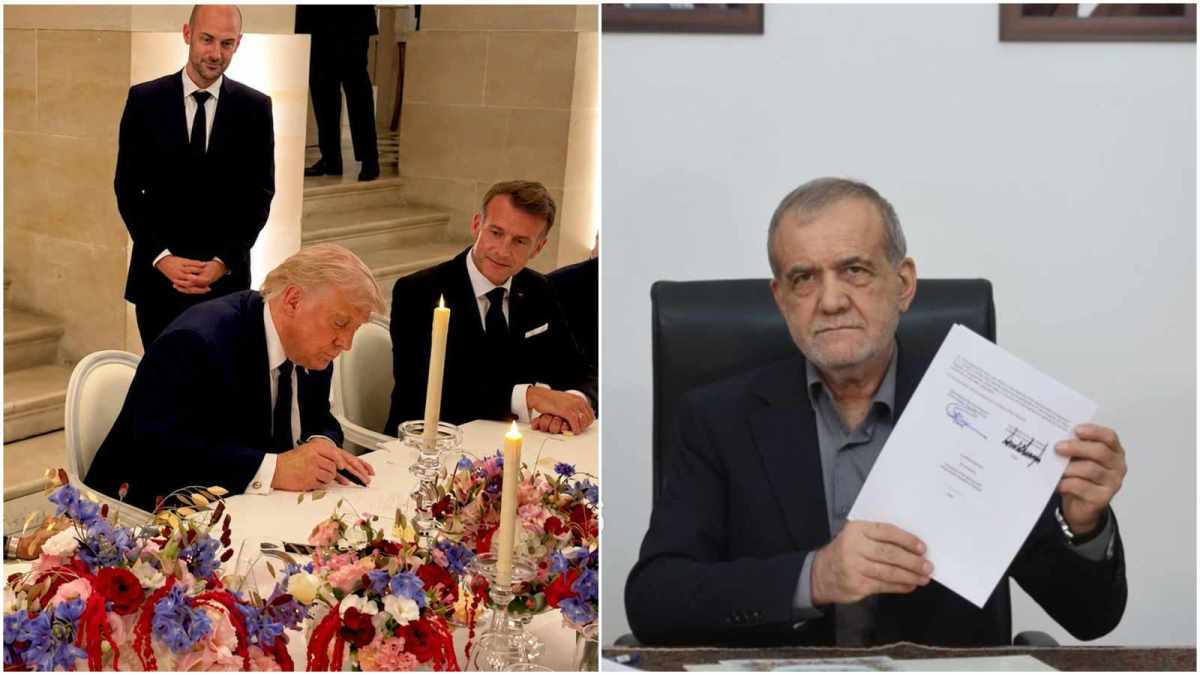
Versailles (France): U.S. President Donald Trump signed the long-awaited memorandum of understanding (MoU) with Iran on Thursday during a dinner with French President Emmanuel Macron at the G7 summit in Versailles, marking a dramatic step toward ending more than three months of war between Washington and Tehran.
As Trump sat alongside Macron, Secretary of State Marco Rubio handed him the agreement. Before signing, Trump paused and remarked: “This was not easy.”
After putting pen to paper, the U.S. president held up the signed document for those gathered in the room.
“President Trump signed tonight at Versailles the agreement between Iran and the United States. This agreement paves the way forlasting peace,” a U.S. official said.
Iranian President Masoud Pezeshkian signed the agreement separately, completing the formal process and bringing the accord into force.
The signing represents the most significant diplomatic breakthrough between the two countries in decades and follows months of conflict, negotiations and mediation efforts aimed at ending a war that drew in Iran, the United States, Israel and regional allies.
The choice of Versailles carried symbolic significance. The historic French palace has hosted some of the world’s most consequential diplomatic agreements, most notably the 1919 Treaty of Versailles that formally ended World War I.
The agreement provides for an immediate and permanent end to military operations, including in Lebanon; the lifting of the U.S. sanctions on Iran and the naval blockade; the reopening of the Strait of Hormuz; and the launch of negotiations on a comprehensive settlement covering sanctions relief and nuclear issues.
Iranian Foreign Ministry spokesman Esmaeil Baqaei said the memorandum had now been signed by the highest authorities of both countries, making any future violation politically costly.
Baqaei said Tehran had deliberately sought signatures from the highest-ranking authorities of both countries.
“When the text is signed by the highest authorities of both countries, violating it will naturally carry greater costs. Given our past experiences, we preferred that this happen,” he said.
The agreement was finalised on Sunday following months of negotiations mediated primarily by Pakistan with support from regional countries. Under its terms, military operations on all fronts, including Lebanon, have ended immediately; the U.S. naval blockade against Iran has been lifted; and the Strait of Hormuz is set to reopen fully to commercial shipping.
While both sides have hailed the accord as a pathway toward peace, Iranian officials have stressed that implementation will be the real test.
“The fact that we have signed an agreement to end the war at this stage does not mean we have forgotten the past or abandoned the costly lessons we have learned,” he said.
“Our work is now harder than before, because implementing international agreements is always much more difficult than drafting them, especially with parties that are not committed to their obligations.”
A 60-day negotiation and verification period will now begin, during which Tehran and Washington are expected to address outstanding issues, including the future of Iran’s nuclear programme, sanctions removal, economic reconstruction and mechanisms for monitoring compliance.