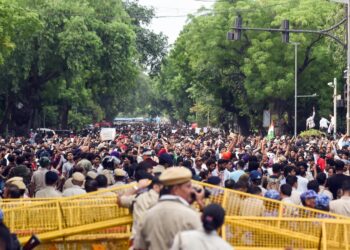


Srinagar: Political leaders in Jammu and Kashmir on Thursday questioned the security crackdown that followed the killing of a police constable in Anantnag, urging authorities to avoid punitive measures that could alienate the public even as they unequivocally condemned the militant attack.
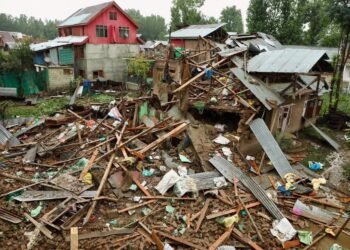
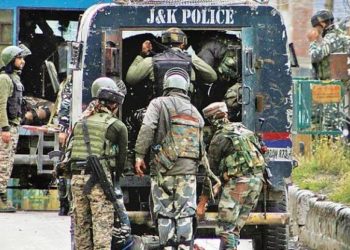
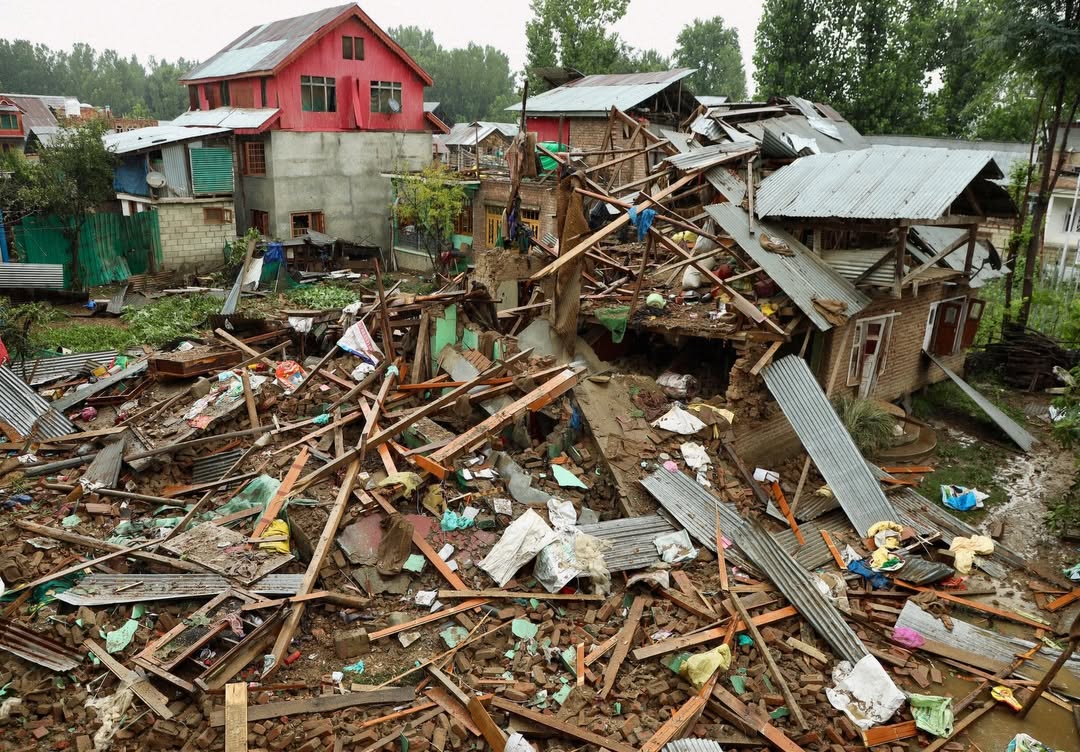
The criticism came a day after Head Constable Ashiq Hussain, who was deployed on Amarnath Yatra security duty, was shot dead by a lone militant at Lal Chowk in Anantnag. Hours later, security forces launched a massive operation across the Valley, detaining more than a thousand suspected overground workers (OGWs), while authorities demolished the houses of two alleged Lashkar-e-Taiba (LeT) militants in south Kashmir.
Chief Minister Omar Abdullah cautioned against “wanton retributive action”, saying the fight against militancy could not be won without carrying the people along.
“I understand the anger of the police, but the Supreme Court has issued an order stating that summary action of this kind should not be taken,” Abdullah told reporters.
Referring to the demolition of houses following the Pahalgam terror attack last year, he said he had then intervened with the Centre to stop the practice.
“Demolishing houses or making thousands of arrests will not improve the situation; in fact, it will only worsen it,” he said.
Drawing on his experience as chief minister, Abdullah said security forces alone could not bring lasting peace.
“We can reach a certain point using the police, Army and the CRPF, but the real end will come only when the general public stands together against such violence,” he said, noting that ordinary Kashmiris had publicly condemned both the Pahalgam attack and Wednesday’s killing of the policeman.
He also expressed concern over reports of mass detentions following the attack, saying such actions risked turning public anger against the system.
National Conference MP Aga Ruhullah Mehdi echoed similar concerns in a post on X, alleging that more than 2,500 people had been detained across Kashmir within 24 hours under the phrase “detained for questioning”, which he said “appears in no statute and carries no safeguard.”
Mehdi also questioned the demolition of two houses during the overnight operation, claiming one of the homes had been rebuilt only months after being demolished previously.
“The Supreme Court has held punitive demolition without due process unconstitutional,” he wrote.
Referring to official claims that local militant recruitment had fallen to zero, Mehdi said, “The same officials detained 2,500 ‘overground workers’ in a day. Both cannot be true.”
At the same time, he strongly condemned the killing of the policeman.
“Head Constable Qureshi was one of our own. His killers deserve the full force of the law. That is justice, and we demand it,” he wrote.
PDP president Mehbooba Mufti also denounced the killing but criticised the government’s response, describing the demolition of homes belonging to the families of “alleged” militants as “collective punishment”.
“The killing of a police officer in the line of duty is a heinous and condemnable act. But detaining over a thousand people and demolishing the homes of families of two alleged militants amounts to collective punishment that has no place in a democracy,” she said in a post on X.
Mufti argued that if the Centre maintained that militancy had been reduced to near zero, it should pursue a “more humane and lawful approach” rather than resorting to what she described as “tit for tat” measures affecting innocent civilians.
Officials said the houses demolished belonged to active LeT militants Adil Thokar and Haroon Rashid Ganaie. Such demolitions had been carried out in the past but had largely stopped over the past year as violence declined.
Security agencies have not publicly responded to the criticism over the detentions and demolitions. Investigations into Wednesday’s attack are continuing.