

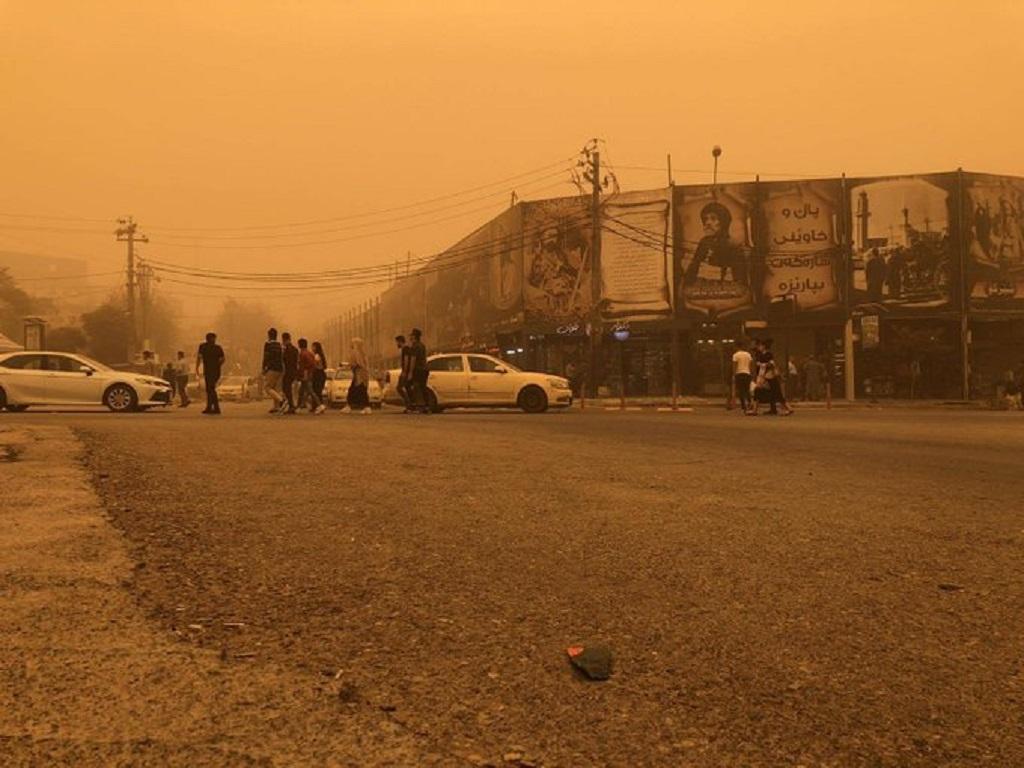
Over eight dust storms hit Iraq in the last six weeks, turning the skies orange and disrupting lives. Climate change may be a driving force, scientists said.
The orange hue across the west Asian country was captured in satellite images by the United States National Aeronautics and Space Administration (NASA) on May 5 and May 16, when two major storms hit. Social media platforms like Twitter and Instagram were also flooded with images of these storms.
Iraq’s weak environmental management policy is also to blame, he added. “The construction of dams on the Euphrates in Turkey led to a reduction in river discharge in Iraq and scarcity of the groundwater, which feeds the lakes.”
This led to a severe environmental change by drying Sawa Lake in southern Iraq, expanding desertification and adding a new dry salty alluvial lake bed that will provide vast material of mud, silt, and salt, the expert said.
The storms are usually driven by Shamal or northwesterly winds. The winds lift dust from the Tigris-Euphrates basin of Syria and Iraq and transport it to the Persian Gulf and Arabian Peninsula, a study stated.
Iraq, which sits at the top of the Persian Gulf, helps in channelling winds, Priyanka Banerjee, INSPIRE Faculty, Divecha Centre for Climate Change at the Indian Institute of Science, told DTE.
The dust season this year is more intense and frequent than usual, Banerjee commented.
Several factors are driving this, but one crucial contributor is La Niña, she added.
La Niña is a climate pattern that impacts weather worldwide. They can influence hurricane season, increase the chance of drought in some regions and trigger intense dust storms over west Asia.
La Niña has been around for the last two years and is expected to make it to the third year as well, according to experts.
When you have La Niña continuously, you have a dry winter, which can affect the dust season the following year, said Singh. “Between December 2021 and February 2022, the region suffered low rainfall.”
During La Nina, the soil loses moisture, too, Banerjee said. Dry sand more readily lifts in the air, leading to dust storms, Singh added.
These storms reduce visibility to one kilometer or less, increasing the risk of accidents.
Climate change link
Scientists think climate change could have been an important driver in increasing the frequency and intensity of these storms.
Long-term changes in air temperature, rainfall, wind speed, soil moisture and relative humidity due to climate change may have had some part to play in fueling the dust storms this year, according to Singh.
A drastic drop in the annual rainfall rate due to climate change can trigger sand and dust storms, studies showed.
Environmental changes like the drying of marshes, land degradation and desertification are also responsible, according to a report.
Drought is another potent ingredient in these storms, Banafsheh Keynoush, a foreign affairs scholar with the Middle East Institute’s Iran Program and a fellow at the International Institute for Iranian Studies, wrote in a blog.
Other human activities also are at play. “The industrial construction of dams weakens water streams throughout the region, thus adding to the severity of droughts,” she highlighted.
Dwindling water underground and poor water management are significant contributors, the expert highlighted. “Water-intensive irrigation systems used along the Iranian-Iraqi border are a factor too.”
Another driving factor may be the draining of wetlands. Iraq lost up to 90 per cent of its marshes by 2000, according to Wetlands International, a non-profit.
The country needs to build better water management practices and adopt suitable irrigation methods to minimize the number of dust storms, Keynoush noted.
Impact on India
Dust storms can travel over thousands of kilometers from west Asia and enter India either through land or the Arabian sea, Singh pointed out. “The Arabian Peninsula is one of India’s major sources of dust storms.”
The other sources are local, from the Thar desert and the Rann of Kutch, he added.
Dust from the Arabian Peninsula reaches over the western parts of India, in Rajasthan after passing through Iran, Iraq, Afghanistan and Pakistan, the expert said. “It can also enter Gujarat through the Arabian Sea.”
The dust touches the Himalayas and can reach the Indo-Gangetic plain too, depending on temperature, wind speed and other meteorological conditions, he said, adding that it can also blow over Assam and Bangladesh.
Dust from west Asia impacts the weather systems of India: It can influence the country’s monsoon, a 2022 study suggested.
The ongoing westerly desert winds from the Arabian Peninsula also can cause heat waves during the summer season in India, according to Raghu Murtugudde, a climate scientist at the University of Maryland, United States, earlier told DTE.
Dust storms are like slow poison, Singh said, adding that dust can transport a range of pollutants:
- Pesticides
- Heavy metals
- Particulate matter (PM10 with diameters less than10 micrometres, and PM2.5 with diameters less than 2.5 micrometres)
- Biological components (bacteria, fungi and spores)
- Potential allergens
- Gases
The dust settles on the Himalayas, creating streaks of red and brown on the snow, according to scientists. As a result, it absorbs more sun, hastening its melting, studies suggested.
Over the Indo-Gangetic Plains, Singh explained, the dust can mix with the anthropogenic emissions of the cities. This can impact the atmospheric chemistry and radiative budget, which is the balance between incoming solar energy and outgoing heat, he added.
The article was originally published by Down To Earth