


Srinagar: An Amicus Curiae appointed by the National Green Tribunal (NGT) has highlighted significant gaps in solid waste and sewage management in Jammu and Kashmir, while calling for stronger safeguards to protect environmentally sensitive water bodies such as Dal Lake and Wular Lake.
In a note submitted before the Principal Bench of the NGT in connection with Original Application No. 606 of 2018, the Amicus Curiae reviewed the compliance affidavit filed by the Union Territory and pointed to deficiencies in waste treatment, sewage management and environmental protection measures.
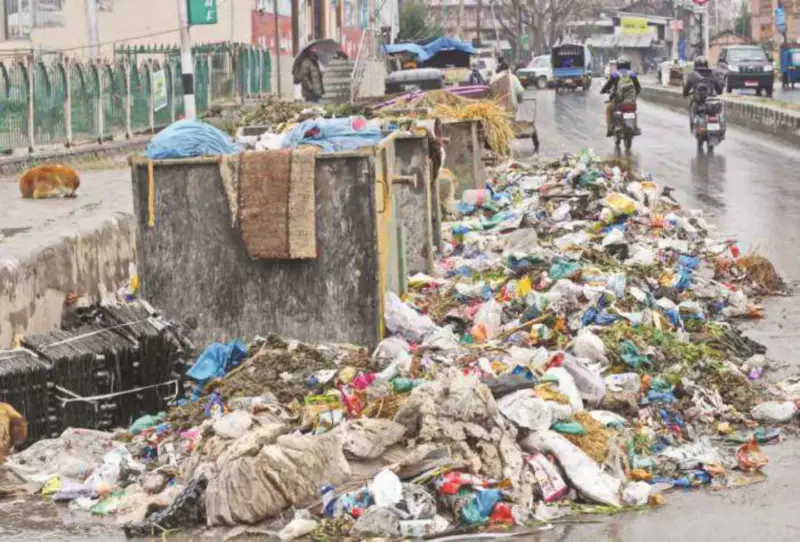
According to the note, Jammu and Kashmir generates around 1,557 tonnes of municipal solid waste every day. While nearly 1,027 tonnes are processed, about 530 tonnes remain untreated daily. The report also noted that nearly 26 tonnes of waste are not collected each day.
The note, accessed by Kashmir Newsville, states that around 352 tonnes of waste are presently being dumped in landfills. It added that authorities are considering the use of Refuse Derived Fuel (RDF) in cement plants, while a 300-tonne-per-day Compressed Bio-Gas (CBG) plant sanctioned for the Union Territory is expected to be completed by March 2027. Two Construction and Demolition (C&D) waste processing facilities are also likely to become operational this year.
The Amicus Curiae expressed concern over the growing burden of legacy waste, observing that nearly 1.816 million tonnes of old waste are lying at 101 identified dump sites spread across 49 urban local bodies.
The report noted that details regarding leachate treatment, land reclamation, site restoration and future utilisation of reclaimed land have not been adequately provided.
It also flagged environmental risks posed by waste processing facilities located near water bodies. Referring to the Bandipora waste management facility near the Wular Ramsar Wetland, the note warned that leachate from dumpsites could contaminate freshwater resources if not managed properly.
The report further pointed to flood-related damage suffered by waste management facilities at RS Pura and Arnia, indicating shortcomings in disaster-resilient planning.
On sewage management, the note stated that Jammu and Kashmir generates 445.647 million litres of sewage every day against an installed treatment capacity of 229 MLD. However, only 137.06 MLD of the available capacity is currently being utilised, leaving a treatment gap of nearly 324 MLD.
The Amicus Curiae also observed that crucial information relating to river water quality, sewage-carrying drains, sludge management and other environmental indicators was not provided in the compliance report.
Among its recommendations, the note called for dedicated conservation and protection plans for Dal Lake and Wular Lake, a complete ban on dumping waste and sewage near water bodies, detailed reporting on leachate management and avoidance of waste treatment facilities near rivers, wetlands and other ecologically sensitive zones.
The report also urged the administration to develop an in-house mechanism for RDF utilisation instead of transporting waste outside the Union Territory.
In addition, it sought a comprehensive status report on industrial effluent management, including details of industrial waste generation, treatment infrastructure, compliance with pollution control norms and disposal of untreated waste.
The observations form part of the NGT’s ongoing scrutiny of waste management practices and environmental compliance across states and Union Territories. (inputs from KNO)