

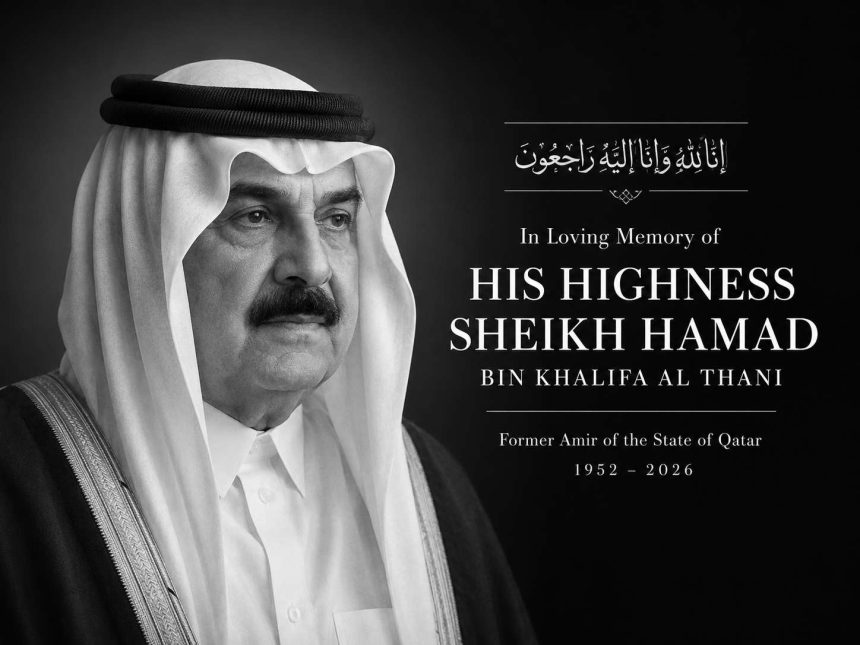
Doha: Sheikh Hamad bin Khalifa Al Thani, the former Emir of Qatar who transformed the tiny Gulf state from an obscure desert nation into one of the world’s most influential diplomatic, financial and geopolitical players, died on Saturday at the age of 74, state media reported.
The state-run Qatar News Agency announced his death but did not disclose the cause.
Sheikh Hamad ruled Qatar from 1995 until his voluntary abdication in June 2013, becoming the first Gulf monarch in modern history to peacefully hand over power to his son while still alive.
During his 18-year reign, he fundamentally reshaped Qatar’s global standing by leveraging its vast natural gas wealth to build international influence through diplomacy, strategic investments, global media and military partnerships.
From Palace Coup to Regional Power
Sheikh Hamad seized power in June 1995 in a bloodless palace coup while his father, Sheikh Khalifa bin Hamad Al Thani, was travelling abroad. The deposed emir remained in exile for nearly a decade before eventually reconciling with the royal family.
At the time, Qatar was a little-known Gulf state with a population of barely two million people, most of them expatriate workers, despite possessing one of the world’s largest reserves of natural gas.
Recognising the country’s limited geographic size and military capabilities, Sheikh Hamad pursued an ambitious strategy that would transform Qatar into an indispensable international player.
His government invested heavily in liquefied natural gas (LNG), helping Qatar become the world’s largest LNG exporter and one of the richest countries in terms of per capita income.
Al Jazeera and Soft Power
One of Sheikh Hamad’s most consequential decisions came in 1996 with the launch of Al Jazeera, a satellite television network that revolutionised Arabic-language broadcasting.
Breaking away from tightly controlled state media common across the Arab world, Al Jazeera became one of the region’s most influential news organisations, giving Qatar unprecedented soft power.
The network gained worldwide attention by broadcasting exclusive messages from al-Qaeda leader Osama bin Laden following the September 11 attacks, while also becoming a platform for debates rarely seen in the Middle East.
Although praised internationally for expanding press freedom in the Arab world, Al Jazeera also generated repeated diplomatic disputes with neighbouring governments that accused it of interfering in their domestic affairs.
Strategic Alliance With Washington
At roughly the same time, Sheikh Hamad made another strategic gamble.
Qatar invested more than USD 1 billion to build Al Udeid Air Base outside Doha, constructing the Gulf’s longest runway and facilities capable of hosting large numbers of combat aircraft.
Following the September 11 attacks, the base evolved into the forward headquarters of the United States Central Command (CENTCOM) and today hosts approximately 10,000 American troops, making it the largest US military installation in the Middle East.
The base has served as the command centre for American military operations in Iraq, Afghanistan and across West Asia.
Despite the enormous strategic value of the installation, Qatar has allowed the United States to use the base without charging rent.
The unusual arrangement enabled Doha to secure one of the world’s strongest military partnerships while maintaining an independent foreign policy.
Global Investment Empire
Sheikh Hamad also turned Qatar into one of the world’s most aggressive overseas investors.
Under his leadership, the Qatar Investment Authority (QIA) emerged as one of the globe’s largest sovereign wealth funds, purchasing stakes in some of the world’s most recognisable assets.
Qatari investments came to include London’s Harrods department store, The Shard, significant portions of Canary Wharf, around 17 per cent of Volkswagen, and French football giants Paris Saint-Germain (PSG).
During the 2008 global financial crisis, Qatar also played a crucial role in recapitalising Barclays Bank after investing billions of pounds in the British lender.
The scale of Qatar’s investments led British media to remark that Qataris owned “more of London than the Queen”.
World Cup and Global Recognition
Perhaps Sheikh Hamad’s most ambitious international project culminated in Qatar hosting the 2022 FIFA World Cup—the first Arab and Middle Eastern country to stage football’s biggest tournament.
Although the successful bid was dogged for years by allegations of corruption and criticism over migrant workers’ rights, the tournament ultimately became one of the most watched sporting events in history.
Sheikh Hamad, no longer emir by then, received a standing ovation from thousands of Qataris when he appeared at the opening ceremony in Doha.
Independent Foreign Policy
Throughout his rule, Sheikh Hamad pursued a foreign policy that frequently diverged from that of Qatar’s Gulf neighbours and Western allies.
Doha maintained working relations simultaneously with Washington and Tehran, hosted senior Hamas officials, cultivated ties with the Muslim Brotherhood and often acted as a mediator in regional conflicts stretching from Lebanon and Sudan to Afghanistan.
That balancing act occasionally placed Qatar at odds with Saudi Arabia, the United Arab Emirates and other Gulf states, culminating in the 2017 regional blockade imposed on Doha.
Despite those tensions, Qatar continued expanding its role as a diplomatic intermediary, hosting negotiations involving the Taliban, Hamas, the United States and numerous international actors.
A Lasting Legacy
Sheikh Hamad voluntarily transferred power to his son, Sheikh Tamim bin Hamad Al Thani, in 2013, ending nearly two decades of transformative leadership.
By the time he stepped down, Qatar had evolved from a little-known Gulf monarchy into a country wielding influence far beyond its size through energy, finance, diplomacy, media and sport.
His legacy remains visible in Qatar’s global investment portfolio, its position as one of the world’s leading LNG exporters, the influence of Al Jazeera, the strategic importance of Al Udeid Air Base and the country’s growing role in international mediation.
For supporters, Sheikh Hamad was the architect of modern Qatar—a leader who converted extraordinary energy wealth into geopolitical influence and global relevance.
For critics, his policies often challenged regional power balances and invited controversy.
Few, however, dispute that during his 18 years in power, Sheikh Hamad bin Khalifa Al Thani transformed Qatar into one of the most consequential small states in modern international politics.