


Dubai: The US military said Thursday it had carried out a new round of strikes against Iranian military targets after President Donald Trump warned Tehran would be hit “very hard” if efforts to secure a peace agreement fail.
The latest strikes, carried out across several Iranian cities, came amid renewed deadlock in efforts to end the conflict. Iran has continued to insist on maintaining its control over the Strait of Hormuz, a vital shipping route whose disruption has rattled global energy markets and pushed oil prices higher.
Tehran vowed retaliation following the attacks. Missile warning sirens were heard in Bahrain, home to the headquarters of the US Navy’s Fifth Fleet, while Kuwait reported that its air defence systems were activated. Iran had launched missiles toward Bahrain, Kuwait and Jordan after the initial round of US strikes on Wednesday.
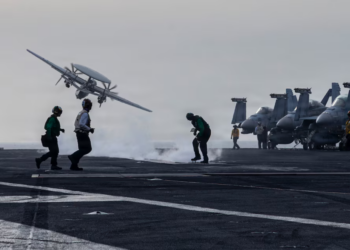
The US Central Command said it had completed its latest operation before dawn, describing the strikes as a response to Iran’s “continued aggression.” According to the military, the targets included Iranian surveillance assets, communication networks and air-defence installations. The operation involved the US Air Force, Navy and Marine Corps, though officials did not provide details on the extent of the damage.
Explosions were reported in Tehran, the port city of Bandar Abbas and other areas along the Strait of Hormuz.
The exchange marked the third flare-up this week despite a two-month ceasefire. Wednesday had already seen Iranian missile attacks targeting Bahrain, Kuwait and Jordan, all of which host US military personnel.
Trump has repeatedly urged Iran to accept a deal to end the conflict, suggesting earlier this week that an agreement could be reached within days. However, Iran’s ambassador to the United Nations, Amir Saeid Iravani, told the UN Security Council that Tehran would not negotiate under threats or pressure.
Despite the escalating violence, both Washington and Tehran appear interested in finding a pathway out of the conflict. Iran believes its ability to disrupt traffic through the Strait of Hormuz provides significant leverage in any negotiations.
The conflict, which began with US and Israeli strikes on Iran on February 28, has unsettled global markets, driving up energy costs and increasing prices of essential goods. Benchmark crude oil prices climbed above USD 93 per barrel on Wednesday, marking a rise of more than 25 per cent since the war began.
Trump claimed the US military has been helping commercial vessels bypass Iranian restrictions in the Strait of Hormuz through a covert operation launched last month. He said more than 100 million barrels of oil had been transported through the waterway despite Iran’s efforts to restrict shipping, though the figure could not be independently verified.
The US military also reported striking the Palau-flagged tanker M/T Settebello after it allegedly attempted to breach the naval blockade while carrying Iranian oil. India’s foreign ministry said three Indian sailors were missing following the incident, while 21 others were rescued.
Iranian officials condemned the US attacks as a violation of the country’s sovereignty. Foreign Minister Abbas Araghchi and Foreign Ministry spokesperson Esmail Baghaei indicated Tehran would reassess its position on negotiations following the latest strikes.
Diplomatic efforts continued in parallel, with a Qatari delegation arriving in Tehran on Wednesday after consultations with US officials.
Major obstacles remain to any peace agreement. Washington is demanding that Iran surrender its stockpile of highly enriched uranium, while Tehran insists on sanctions relief and the release of frozen assets. Iran has also linked any settlement to an end to hostilities between Israel and Hezbollah, a condition Israel has shown little willingness to accept.
With both sides holding firm on key demands, prospects for a quick resolution remain uncertain despite ongoing diplomatic efforts.