

DUBAI: Iran’s Revolutionary Guards said they had struck US military targets and bases in UAE, Jordan, Bahrain, Qatar, Bahrain, Oman and Kuwait, state media reported on Monday.
The official news agency IRNA cited several statements released by the Guards saying they had attacked Prince Hassan Air Base in Jordan, a US military drone command center in Bahrain and air bases including Ali Al-Salem in Kuwait.
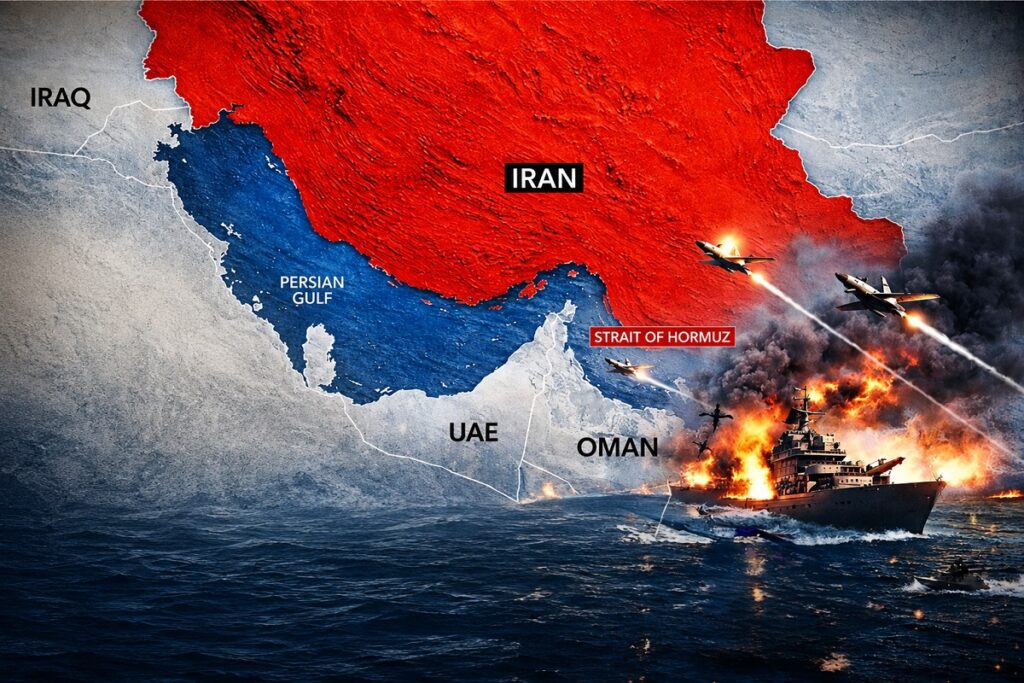
Iran said Sunday it was closing the Strait of Hormuz and launched missiles and drones at Gulf neighbors after the US carried out a new round of strikes as their conflict escalated.
The latest exchange of fire was sparked by another Iranian attack on a commercial ship in the strait, whose crew were forced to abandon the vessel after it went up in flames.
The escalation is the latest to undermine an interim agreement between Washington and Tehran aimed at ending their war, which broke out in late February with US-Israeli strikes that killed Iran’s supreme leader.
Mediators have been trying to salvage a diplomatic solution after President Donald Trump this week declared a ceasefire over.
The regional barrage came just hours after the United States carried out a third round of airstrikes against Iranian targets in retaliation for attacks on commercial shipping in the Strait of Hormuz.
Qatar’s military said in a statement it intercepted incoming Iranian fire, with explosions heard in neighboring United Arab Emirates.
Meanwhile, missile alerts sounded in Bahrain, home to the US Navy’s 5th Fleet. Kuwait’s military also said it was intercepting incoming fire.
The United Arab Emirates said its defense systems engaged missiles and drones from Iran. In a statement, the ministry of defense said the missile threats detected this morning.
An Omani security source reported that drones have targeted sites in the governorate of Musandam.
The Oman News Agency said on X that “the Sultanate of Oman affirms its condemnation and denunciation of this attack,” which came just hours after the country hosted Iran’s foreign minister to address security issues in the Strait of Hormuz.
The sultanate also summoned the Iranian ambassador to hand him a formal note of protest, in a rare instance of it publicly accusing Tehran of targeting its territory.
“Oman expresses its profound dismay at these irresponsible acts, and underscores the imperative of adhering to the provisions of state sovereignty, good neighborliness, non-interference in internal affairs,” ONA said in a post on X.
In Jordan, three Iranian missiles fell early Sunday morning across several locations inside the Kingdom. No casualties were reported, and the impact resulted only in minor material damage.
The latest exchange marked another sharp escalation after US President Donald Trump declared that an interim ceasefire with Iran was “over,” while saying Washington remained open to negotiations on a permanent settlement.
US Central Command said it launched fresh strikes on Iranian targets on Trump’s orders after Iran’s Islamic Revolutionary Guard Corps attacked a Cyprus-flagged container ship transiting the Strait of Hormuz. According to the US military, the vessel suffered significant engine-room damage and one civilian crew member was reported missing.
Iran’s Revolutionary Guards said several vessels had ignored what it described as approved navigation routes through the strategic waterway. One vessel, it said, was struck by a “warning shot” and forced to stop.
Tehran also declared that the Strait of Hormuz would remain closed “until further notice” and warned it could target additional US military facilities in the region if further attacks were launched against Iran.
The United States has rejected Iran’s claim to exclusive control over the strait, demanding that Tehran publicly guarantee freedom of navigation and halt attacks on commercial shipping before broader negotiations can advance.
US officials said Washington views unrestricted maritime traffic through the waterway as a prerequisite for any future agreement over Iran’s nuclear program and regional security. They also said any nuclear deal would require Iran to surrender its stockpile of highly enriched uranium.
Iran’s ambassador to the United Nations, Amir Saeid Iravani, insisted this week that all activity in the Strait of Hormuz, including reopening the shipping lane or conducting demining operations, “rests exclusively with Iran.”
The Strait of Hormuz carries roughly one-fifth of the world’s traded oil and natural gas under normal conditions, making it one of the world’s most strategically important maritime chokepoints. Iran’s restrictions on shipping during the conflict triggered a global energy shock before oil prices retreated from wartime highs.
Iran said those attacks targeted US military installations across the three countries and warned that other American bases in the region would remain vulnerable if Washington continued military operations.
The latest exchange further clouds efforts by regional mediators, including Pakistan, Qatar and Oman, to restore the ceasefire and resume negotiations over Iran’s nuclear program, maritime security and broader regional stability.