


Have you ever wondered that humans cannot perform any act without the involvement of environment? Even while sleeping, you are exhaling CO2 and inhaling oxygen! While pursuing our various activities, be it economic, social, entertainment, travelling among others, we tend to add our ecological footprints to the planet. It may be adding eco-burden to the planet through various ways like polluting the air, water, soil or a rise in temperature etc.
Interestingly, the planet has the bio capacity to absorb the pollution created by us and revive and heal itself. However, due to overuse, misuse and abuse of the resources of the planet coupled with the hyper-speed of human activities and the resultant pollution, the bio capacity of the planet may be compromised. The alarming aspect is that we may have already exhausted the bio capacity of the planet.
Planet Earth is in the midst of a climate catastrophe. The land, water, air is polluted to a dangerous scale resulting in environmental crisis. Global warming has reached near-irreversible levels. One of the major causes of this climate crisis is greenhouse gases (GHGs), which directly cause global warming and many other collateral problems. These GHGs increase the planet’s ability to trap infrared energy and thus affect the climate. Greenhouse gases are CO2 (carbon dioxide), methane, nitrous oxide, hydrofluorocarbons (HFCs), etc. Each one of us have contributed to this through our carbon footprints, which is the sum total of greenhouse gas emissions per person (or per product or per organisation).
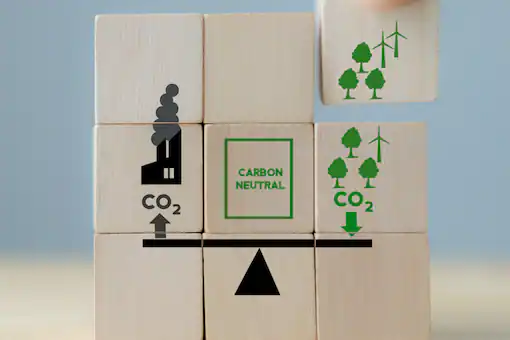
If we are to survive as a species, we have to reduce our carbon footprint. The only plausible way out is by reducing per capita emission of carbon. At the global level, world leaders have argued that there should be a limit on the level of carbon emissions by each country. We can reduce carbon footprints by either a) setting a limit on carbon emissions or; b) by promoting carbon-neutral technologies.
For this, the world community created a market-based trading known as carbon trading. The Kyoto Protocol introduced a carbon credit system that imposed national caps on greenhouse gas emissions by developed nations who ratified this protocol.
CARBON TRADING
– A carbon credit equals one metric tonne of CO2 or a hydrocarbon fuel. Carbon trading is an exchange of credits between nations designed to reduce emissions of carbon dioxide.
– Carbon trading is based on the principles of cap and trade. You have a cap on the limit of carbon emissions and if you hit above or below the cap, you can trade (buy and sell) the carbon emissions. Carbon credit is like rationing or setting quota of agreeable emission of carbon into the atmosphere at individual, corporate and country level with an aim to reduce greenhouse gases. At individual level, the carbon trade allows individual companies to trade polluting rights through a regulatory system known as cap and trade. Companies that pollute less can sell their unused pollution rights to companies that pollute more.
– It simply means that if you use less than the permissible limit by way of less emission of carbon you can sell off your carbon credits. Conversely, if you exceed your carbon credit limits, you have to buy the extra carbon credits from those who have carbon credits. Say, for example, Country A has been allotted a permissible limit of 1000 units of carbon but it uses only 800, it saves a net carbon credit of 200.
BENEFITS OF CARBON TRADING
– It sets overall limits of carbon emissions by countries and corporates. Thus, it caps carbon emissions the world over.
– It incentivises those who invest in carbon-neutral or carbon-plus technologies which help in overall reduction of carbon emissions. It forces nations to invest heavily in low carbon-intensive technologies and switch to renewable energy and work towards protecting forests. Also, it is a kind of punitive-disincentive for those who exceed their carbon emission limit.
– Carbon credits are most often earned through agricultural or forestry practices, although a credit can be earned by nearly any project that reduces, avoids, destroys or captures emissions. Thus, it promotes environment. For example, if your company emits 100 units of carbon, you can buy carbon credit by investing in a venture like plantation which has a direct bearing on carbon emission. The United Nations Framework Convention on Climate Change (UNFCCC) now allows countries to earn carbon credits from planting trees, which function as carbon sinks.
INDIA AND CARBON EMISSIONS
As per global data, India’s CO2 emissions were 1.74 metric tonnes per capita in 2021, which is way lower than many of the developed countries. The Indian government is actively pursuing its environmental responsibility which is emanating from its rich environmental ethos. At the 26th Conference of the Parties (CoP26), Indian Prime Minister Narendra Modi declared a five-fold strategy — termed as the Panchamrita — to achieve this feat. The five points include:
– By 2070, India will achieve the target of Net Zero emission. This aim is India’s commitment which is a direction for other nations to follow.
– India will meet 50 per cent of its energy requirements from renewable energy by 2030. This will make the Indian economy a true green economy where the thrust will be on investment in low carbon technologies.
– India will reduce the total projected carbon emissions by one billion tonnes from now till 2030.
– By 2030, India will reduce the carbon intensity of its economy by less than 45 per cent.
– India will get its non-fossil energy capacity to 500 gigawatt (GW) by 2030.
India has a huge potential for monetisation of carbon credits. As per one media report, Indian companies have registered 1,669 projects under clean development mechanism (CDM) and earned 246.6 million credits; another 526 projects were registered under the ‘voluntary’ market and these have earned 89 million credits. Thus, in all, Indian companies earned roughly 350 million credits. India is heading towards becoming a truly green and clean economy.
Geetanjali Mehra is an interior designer by profession. The views expressed in this article are those of the author and do not represent the stand of Kashmir Newsville. (News 18)

Kashmir Newsville Is A Multimedia News Platform.
Registered By The Government Of India, Registrar Of Newspapers For India Under: JKENG/2023/87898