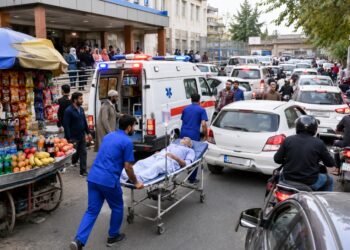



GAZA: More air strikes rained down destruction on the city of Khan Yunis on Monday, while deadly fighting and bombing shook the central and northern parts of the besieged enclave.
The health ministry said the death toll has risen to 18,205 in the Palestinian territory, mostly women and children. Some 49,645 people have been wounded since Oct 7, ministry spokesman Ashraf al-Qudra said in a statement.
The United Nations, meanwhile, marked 75 years of its human rights declaration in the shadow of the ongoing crisis. UN envoys, however, travelled to Egypt to meet Gazan victims on Monday, days after the United States blocked a ceasefire resolution.
In central Gaza, AFPTV images showed a volcanic-like cloud of grey smoke rising after an explosion and automatic weapons fire. Also, AFP visited the Al-Shifa hospital complex in Gaza City and found at least 30,000 people taking refuge amid the rubble outside after Israeli forces raided the facility last month.
The air strikes that hit Rafah, near Egypt, killed seven of Umm Mohammed al-Jabri’s children after the family fled there from Gaza City, she said. “I have four children left out of 11,” she said.
“Last night they bombed the house we were in and destroyed it. They said Rafah would be a safe place. There is no safe place.” In the nearby Al-Rimal area, a correspondent saw thousands of Palestinians had also set up camp at a headquarters of the UN agency for Palestinian refugees (UNRWA). The correspondent said both the Islamic and adjacent Al-Azhar universities had been reduced to rubble, as had the police station.
‘Death will follow us’
An estimated 1.9 million of Gaza’s 2.4 million people — about 80 percent of the population — have been displaced, according to UN figures. Many are now in the south and running out of safe places to go.
Hundreds of thousands of displaced people are still believed to be in the heavily-bombed north.
On Saturday the Israeli army again told residents in the north to evacuate to safe areas — but international organisations have condemned the lack of areas free from bombardment in the narrow coastal strip.
Hospitals have been hit repeatedly. On Sunday, Gaza’s health ministry reported damage from a strike at the Jordanian field hospital in the southern city of Khan Yunis.
Gazans are desperate.
Souhail Abou Dhalfa said his family sought refuge at Al-Shifa after his 20-year-old son was wounded when their house was hit by relentless bombardment in Shejaiya, in the east of Gaza City.
“We put together a tent”, the 56-year-old said. “We don’t know if they will storm Al-Shifa again, and it doesn’t matter — wherever we go, death will follow us.”
Raed, who gave only his first name, has been sleeping on an old blanket under the stairs near the former emergency ward.
The 24-year-old’s family of nine has no money for a tent, he said.
His eight-year-old sister Manal sleeps with her head on a bundle of clothes.
Beside her, their mother keeps watch over a bottle of water, some bread and cheese.
UN envoys ‘destroyed’ by Rafah scenes
The informal one-day trip of UN envoys, organised by the UAE and Egypt came amid a spiralling humanitarian crisis in Gaza.
Around a dozen ambassadors took part from countries including Russia and Britain. But the US, which vetoed the Security Council resolution calling for a ceasefire on Friday, did not send a representative, and neither did France.
The envoys visited a hospital in El-Arish near the Rafah border crossing with Gaza, treating people who had been evacuated from the Israeli assault.
Among the people they met was Wafaa Asaad, a 27-year-old from Gaza who was heavily pregnant when her house was hit by an Israeli strike, killing her husband and injuring her two daughters.
She was evacuated to Egypt for medical treatment and had an arm and leg amputated, but miraculously managed to give birth just hours after crossing the border, her sister Alaa said.
Ecuador’s envoy Jose de la Gasca said he was “destroyed” by the visit to the hospital. “I just met a young mother who lost a kid and has another little girl who is wounded,” he said.
“I don’t ever want to see again what I have just seen. It’s horrible.”
In addition, the UN human rights chief urged countries on Monday to work together to defeat threats such as war and pollution at an event to mark 75 years of the Universal Declaration of Human Rights that risks being overshadowed by Gaza crisis.
Ministers, diplomats and activists attended the Geneva event where Volker Turk invoked the spirit in which the newly-formed UN adopted the declaration in December 1948, in response to what the document calls “barbarous acts which have outraged the conscience of mankind”.
Meanwhile, the UN General Assembly is due to meet on Tuesday (today) to discuss the humanitarian crisis in Gaza.