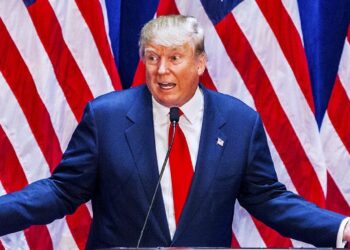



Srinagar: US President Donald Trump’s sweeping set of tariffs targeting more than 90 countries came into force just after midnight Thursday, marking a significant escalation in the trade offensive. “It’s midnight! Billions of dollars in tariffs are now flowing into the United States of America!” Trump wrote on Truth Social.
In an earlier post on Wednesday, Trump had said: “Reciprocal tariffs take effect at midnight tonight! Billions of dollars, largely from countries that have taken advantage of the United States for many years, laughing all the way, will start flowing into the USA.”
India, as part of the first tranche, faces 25 per cent tariffs. However, this was doubled on Wednesday by the US President to 50 per cent, with the addition 25 per cent kicking in after a 21-day window.
A White House statement said the US will impose “additional 25 per cent ad valorem duty” above the 25 per cent reciprocal tariffs announced on August 1 to “deal with the national emergency stemming from Russia’s actions in Ukraine”. This tariff is deemed necessary and appropriate due to India’s “direct or indirect import of Russian Federation oil”, which the President judges will more effectively address the national emergency, the executive order said.
Before Thursday, goods into America saw a minimum 10 per cent tariff but now the rates vary for different countries. While the highest rates imposed are on goods from Brazil (50%), Laos (40%), Myanmar (40%), Switzerland (39%), Iraq (35%) and Serbia (35%), 21 countries face levies greater than 15% — Vietnam (20%), India (25%), Taiwan (20%) and Thailand (19%).
Tariffs on other countries
Here are the present tariff rates at a glance:
| Country | Tariff (%) |
Afghanistan | 15% |
Algeria | 30% |
Angola | 15% |
Bangladesh | 20% |
Bolivia | 15% |
Bosnia and Herzegovina | 30% |
Botswana | 15% |
Brazil | 10% |
Brunei | 25% |
Cambodia | 19% |
Cameroon | 15% |
Chad | 15% |
Costa Rica | 15% |
Côte d`Ivoire | 15% |
Democratic Republic of the Congo | 15% |
Ecuador | 15% |
European Union | 0%–15% |
Equatorial Guinea | 15% |
Falkland Islands | 10% |
Fiji | 15% |
Ghana | 15% |
Guyana | 15% |
Iceland | 15% |
India | 25% |
Indonesia | 19% |
Iraq | 35% |
Israel | 15% |
Japan | 15% |
Jordan | 15% |
Kazakhstan | 25% |
Laos | 40% |
Lesotho | 15% |
Libya | 30% |
Liechtenstein | 15% |
Madagascar | 15% |
Malawi | 15% |
Malaysia | 19% |
Mauritius | 15% |
Moldova | 25% |
Mozambique | 15% |
Myanmar (Burma) | 40% |
Namibia | 15% |
Nauru | 15% |
New Zealand | 15% |
Nicaragua | 18% |
Nigeria | 15% |
North Macedonia | 15% |
Norway | 15% |
Pakistan | 19% |
Papua New Guinea | 15% |
Philippines | 19% |
Serbia | 35% |
South Africa | 30% |
South Korea | 15% |
Sri Lanka | 20% |
Switzerland | 39% |
Syria | 41% |
Taiwan | 20% |
Thailand | 19% |
Trinidad and Tobago | 15% |
Tunisia | 25% |
Turkey | 15% |
Uganda | 15% |
United Kingdom | 10% |
Vanuatu | 15% |
Venezuela | 15% |
Vietnam | 20% |
Zambia | 15% |
Zimbabwe | 15% |
While some allies like the UK, Japan, and South Korea have negotiated lower tariffs, others, including Canada, saw rates rise. Canada’s tariff was increased from 25% to 35% after Trump accused it of failing to control fentanyl trafficking. However, most Canadian exports remain protected under the USMCA trade deal.
Tariffs on Mexican goods have been temporarily paused for 90 days as negotiations continue.
The European Union reached a framework deal with Washington, accepting a 15% tariff on EU goods in exchange for concessions, reported BBC.
(With inputs from BBC, Reuters, PTI)