


Dubai: In a bizarre sequence of events, the Asia Cup trophy was not awarded to champions India at the presentation after they refused to accept the silverware from Pakistan minister and ACC president Mohsin Naqvi.
India had refused to collect the Asia Cup from Pakistan Cricket Board (PCB) chief Mohsin Naqvi, who also serves as the president of the Asian Cricket Council. It was widely speculated that India would take this stand amid tensions between the two countries, particularly given Naqvi’s dual role as a government minister in Pakistan and his provocative social media post during the tournament.
The presentation ceremony finally began after a long delay but only individual performers were feted. Despite India’s refusal to accept the trophy from him, Naqvi stood firm on the stage and eventually the trophy was not awarded to the winning team probably the first time on a cricket field.
India informed the officials that they were willing to receive the trophy from Emirates Cricket Board vice-chairman Khalid Al Zarooni, who was sharing the stage with Naqvi. However, Naqvi did not permit this to happen.
When it became clear that the team would not collect the trophy, the dignitaries left the stage and announced that India had formally declined to accept it.
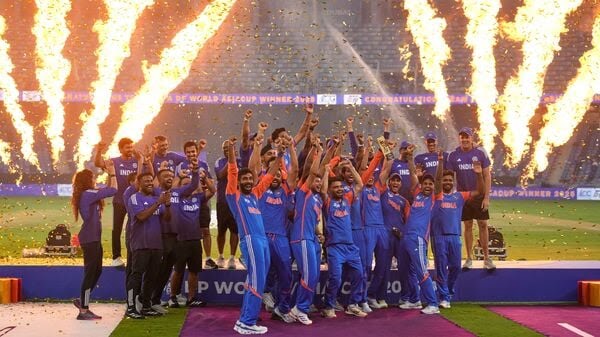
Only after their departure did the Indian team return to the dais. Confetti was released, the victory song rang out, and the players posed for photographs, celebrating with fans. Yet the trophy remained conspicuously absent. Having marked their triumph in their own way, India left the stadium without the silverware
While Pakistan players were handed their runners-up medal and Abhishek Sharma and Tilak Varma collected the Player of the Series and Player of the Tournament awards, repsectively, captain Suryakumar Yadav did not collect the trophy on Sunday.
Pakistan captain Salman Ali Agha criticised India over their handshake snub and their decision not to receive the trophy from Mohsin Naqvi. Suryakumar Yadav had refused to shake hands with Salman during the group-stage game on 14 September, which triggered the series of controversies that followed.
“What India did with us (not shaking hands, not taking the trophy from Mohsin Naqvi) – they are not only disrespecting us, they are also disrespecting the sport of cricket,” Salman said after the final.
“Looking at this, what if other teams also start doing the same? Where will we draw the line, where will this stop? Cricketers are supposed to be role models; what will kids learn watching this kind of behaviour on the field? Whatever happened in this tournament was very bad,” he added.
A Final for the Ages
The final of Asia Cup 2025 will not fade quickly from memory. It had all the elements of an epic: Tilak’s coming-of-age knock, Pakistan’s dramatic collapse and the surreal absence of a trophy lift.
It was a reminder that when India and Pakistan meet, the boundary between sport and politics dissolves. Every gesture, every ball, every refusal carries weight far beyond the field.
For India, the night was about triumph in adversity and sending a message of defiance. For Pakistan, it was a bitter cocktail of collapse and embarrassment. And for the rest of the world, it was proof once again that this rivalry is not just cricket—it is theatre, war and history colliding under flood lights.