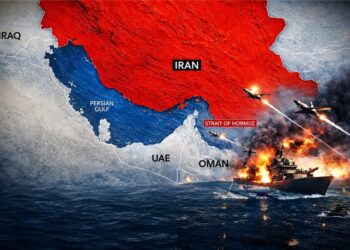


New Delhi: India on Thursday flagged grave concerns over the West Asia crisis and its impact on energy supplies and maritime stability in the Strait of Hormuz and urged BRICS nations to develop “practical ways” to navigate geopolitical upheavals as well as “unilateral coercive” sanctions.
In his address at the opening day of a two-day BRICS conclave here, External Affairs Minister S Jaishankar asserted, without naming specific nations, that respect for sovereignty and territorial integrity must anchor international relations, maintaining that “dialogue and diplomacy” offer the only sustainable path to conflict resolution.
Jaishankar said India stands ready to contribute constructively towards de-escalation efforts and to support initiatives aimed at restoring stability while noting that “peace cannot be piecemeal” and “it is essential to uphold international law, protect civilians, and avoid targeting public infrastructure.”
The external affairs minister also strongly pitched for ensuring safe and unimpeded maritime flows through the Strait of Hormuz and Red Sea and voiced concerns over the “grave humanitarian implications” of the conflict in Gaza.
The India-hosted meet assumed greater significance as the influential bloc grapples with the economic consequences of the West Asia crisis, particularly the severe energy supply disruptions and Washington’s policy on trade and tariffs.
Iranian Foreign Minister Abbas Araqchi, Russian Foreign Minister Sergey Lavrov, Brazil’s Mauro Vieira, Indonesian Foreign Minister Sugiono and South Africa’s Minister for International Relations Ronald Lamola is among the senior leaders attending the meeting.
“The conflict in West Asia merits particular attention. Continuing tensions, risks to maritime traffic, and disruptions to energy infrastructure highlight the fragility of the situation,” Jaishankar said.
The external affairs minister said safe and unimpeded maritime flows through international waterways, including the Strait of Hormuz and the Red Sea, remain vital for global economic well-being.
“The wider region also gives rise to serious concern. The conflict in Gaza has grave humanitarian implications.
“A sustained ceasefire, humanitarian access, and a credible pathway towards a durable and peaceful resolution remain essential. India supports a two-state solution where the Palestine issue is concerned,” he said.
Jaishankar also made a mention of challenges facing Lebanon and Syria as well as the prevailing situation in Sudan, Yemen and Libya while calling for sustained international engagement and coordinated diplomatic efforts to address them.
“Taken together, they underline a clear reality: stability cannot be selective, and peace cannot be piecemeal. It is essential to uphold international law, protect civilians, and avoid targeting public infrastructure.”
“India stands ready to contribute constructively to de-escalation efforts and to support initiatives aimed at restoring stability,” Jaishankar said.
Without naming any country, he also underlined the need for addressing what he called “the increasing resort to unilateral coercive measures and sanctions inconsistent with international law and the UN Charter”.
“Such measures disproportionately affect developing countries. These unjustifiable measures cannot substitute dialogue, nor can pressure replace diplomacy,” he said.
The external affairs minister also described terrorism as a “continuing threat” and said that there can be no justification for terrorism in any form.
PM Modi Meets BRICS Ministers
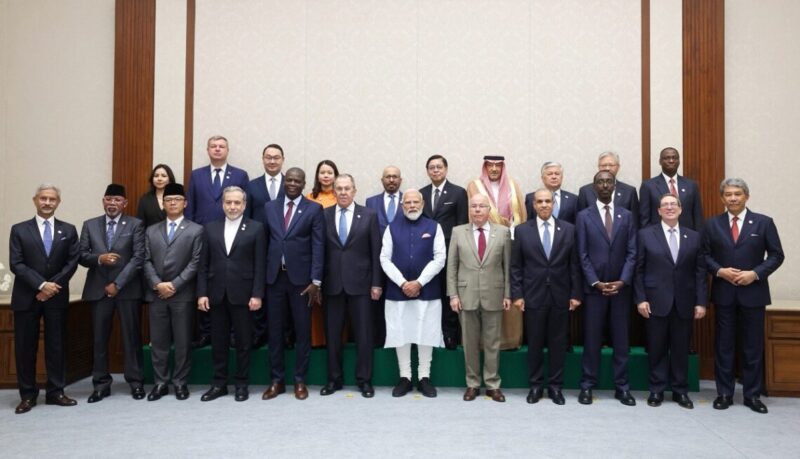
Prime Minister Narendra Modi on Thursday hosted top diplomats from the BRICS nations as New Delhi kicked off a high-stakes conclave of the foreign ministers of the influential bloc.
The visiting dignitaries, who made a joint call on the prime minister, included Russian Foreign Minister Sergey Lavrov, Iran’s Abbas Araqchi, Brazil’s Mauro Vieira, Indonesia’s Sugiono, and South Africa’s Ronald Lamola.
The India-hosted meet assumed greater significance as the influential bloc grapples with the economic consequences of the West Asia crisis, particularly the severe energy supply disruptions and Washington’s policy on trade and tariffs.
India, as the chair of the BRICS, is hosting the two-day conclave from Thursday ahead of the annual summit of the grouping in September.
BRICS, originally comprising Brazil, Russia, India, China, and South Africa, expanded in 2024 to include Egypt, Ethiopia, Iran, and the United Arab Emirates, with Indonesia joining in 2025.
It has emerged as an influential grouping, as it brings together 11 major emerging economies of the world, representing around 49.5 per cent of the global population, around 40 per cent of the global GDP and around 26 per cent of the global trade.
The BRICS meeting will be chaired by External Affairs Minister S Jaishankar.(PTI)