

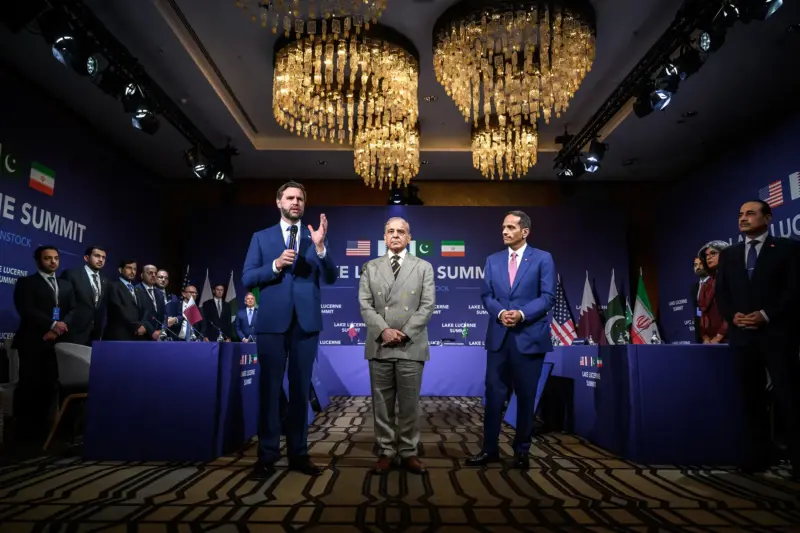
Zurich: US Vice President JD Vance, Iran’s Parliament Speaker Mohammad Bagher Ghalibaf and Pakistan Prime Minister Shehbaz Sharif arrived in Switzerland on Sunday for high-level talks aimed at restoring peace in West Asia.
US Vice President JD Vance arrived in Zurich on Sunday morning, joining senior American negotiators already in Switzerland, while Iranian Parliament Speaker Mohammad Baqer Qalibaf led Tehran’s delegation. Pakistani Prime Minister Shehbaz Sharif, whose government helped broker the deal, also arrived along with Army Chief Field Marshal Asim Munir.
The meeting in the Swiss resort of Bürgenstock marks the first high-level engagement since US President Donald Trump and Iranian President Masoud Pezeshkian signed a 14-point memorandum of understanding (MoU) earlier this week aimed at ending months of conflict and opening negotiations between Iran and the United States.
But Iranian officials signalled that Sunday’s talks would focus on whether Washington is fulfilling its obligations under the agreement.
“The start of negotiations for a final agreement is conditional on five specific clauses, including clause one of the MoU, which concerns the cessation of hostilities on all fronts, including Lebanon,” Iranian Foreign Ministry spokesman Esmaeil Baqaei told reporters.
“We know that this clause has not been implemented and that the US has not been able to or has not wanted to. The Zionist regime keeps violating its commitment. This is the main topic of discussions in today’s talks,” he said.
The talks were originally scheduled for Friday but were postponed after Iran objected to continued Israeli military operations in Lebanon, arguing that they violated the spirit and terms of the agreement.
Baqaei said Sunday’s meeting would test Washington’s willingness to enforce the deal.
“We had no intention of signing a document while expecting that it would be automatically implemented by the other side,” he said. “We never forget previous experiences.”
Vance struck a more optimistic tone before departing for Switzerland.
“My understanding, talking to Jared and Steve this morning, is things are going well,” he told Fox News, referring to senior US negotiators Jared Kushner and Steve Witkoff.
Senior Delegations in Switzerland
Vance arrived in Zurich on Sunday morning while Witkoff and Kushner were already in Switzerland preparing for the talks.
Iran’s delegation is being led by Qalibaf and includes Foreign Minister Abbas Araqchi, Deputy Secretary of the Supreme National Security Council Ali Baqeri Kani and Central Bank Governor Abdolnaser Hemmati.
Pakistan’s Prime Minister also arrived in Zurich accompanied by Munir and senior officials. Pakistani Interior Minister Mohsin Naqvi travelled to Switzerland with the Iranian delegation.
Islamabad, which mediated months of negotiations between Tehran and Washington, signed the MoU as a guarantor and is expected to play a key role in Sunday’s discussions.
“Pakistan will continue to facilitate the process in its role as mediator, with a view to advancing the understandings reached under the Islamabad Memorandum of Understanding,” Pakistan’s Foreign Office said in a statement.
Qatari representatives, who also helped broker the agreement, are expected to participate.
IRNA reported that Iranian Foreign Minister Araqchi met Swiss Foreign Minister Ignazio Cassis ahead of the talks.
Hormuz Closure Adds Pressure
The negotiations are taking place amid fresh uncertainty over the Strait of Hormuz, the strategic waterway through which roughly one-fifth of global oil supplies pass.
The MoU requires Iran to restore maritime traffic through the strait and commits the United States to lifting its naval blockade of Iran.
But on Saturday, Iran’s central military command announced that it had closed the strait again, citing what it called US and Israeli violations of the agreement.
Iranian officials accused Washington of failing to stop Israeli military attacks on Lebanon, arguing that the first clause of the agreement had been breached.
The move raised fears of renewed disruptions to global energy supplies and added urgency to the Swiss talks.
Iran insists that implementation of the agreement must precede any discussion of a final settlement.
The 14-point agreement calls for a permanent end to hostilities, a phased lifting of US sanctions, removal of the naval blockade within 30 days, restoration of commercial shipping through Hormuz and negotiations toward a final settlement within 60 days.
Diplomats say the outcome of Sunday’s talks could determine whether the agreement evolves into a broader peace process or collapses under the weight of continued regional tensions.